An influence not to be dismissed

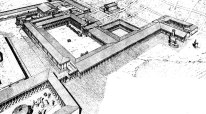
parthenon-drawing
The Parthenon © Chris Conway

I’ve always been proud of my (half) Greek heritage. As I was growing up I felt that it enabled me to think differently and see life through more than one lens, which I saw as something special.   And it didn’t stop there.

The more tenuous connection between Greeks today and their ancient forbears didn’t stop any additional thoughts I had of laying claim to a small part of all the best of their great Classical Greek heritage. What more proof did I need than the ancient Greek words I could pick up in modern day conversation? The remaining monuments themselves, testament to that great civilisation: the Parthenon, ravaged so many times by unwelcome pillagers and yet still there!  As I studied the ancient language and learnt about the civilisation I continued to make my connections from ancient to modern with a degree of satisfaction.

But that’s just my personal view. Well known to most is the legacy that the “Classical” Greek civilisation left to modern western thought and philosophy. A society that lasted at its peak for less than 200 years and yet continues to influence some of our thinking, our teachings and provided the foundation for parts of our modern western culture over two thousand years later. Whilst other cultures have certainly influenced our development what is most striking is the limited time and small scale that was “Classical Greece”.

There are other links too that are less acknowledged but equally remarkable for their sophistication so long ago. Take today’s communication through social media and the digital space it sits in?

In Classical Greece the “agora” (from the Greek “ὰγορᾱ” meaning gathering place or mil_northmarket2assembly) was the place where “citizens” including philosophers, artists, playwrights, artisans, thinkers and decision makers , met to demonstrate new skills, discuss and exchange ideas and information about the future of society. Every person in the agora was equal and “no-one subjected to another”  It was an open public forum that was democratic. All it lacked was today’s technology and digital social networks. But the concept was the same – it was a “common space” that could be accessed by all citizens on an equal footing and involved the sharing of multiple common beliefs or opinions (Πολυδόξα) both commercial, political and social. Whilst the link back to Roman times, where the written word became transportable on small parchments has been documented ,for me “social” communication started in the ancient Greek agora itself and rested on the principle of open and shared communication.
4090820230_dc7b70b880_m
Sculptural relief: Plato and Aristotle in heated debate!

Plato and Aristotle, two of the best known philosophers of the classical world, would have visited the agora regularly, standing in the shade of the colonnades espousing their views on different subjects. Their perspective on art and artists was well known and recorded [Plato’s Republic and Aristotle’s Poetics].

Plato completely disagreed with his pupil Aristotle viewing art as merely “an imitation” or “mimesis” (μίμεσις) and “thrice removed from reality” that had no connection with those that possessed a real skill (tέχνη) – (like the medics, the builders and the mathematicians)

Both focused their attention on the theory of mimesis and the principle that all art was a form of it. But it was the “imitative function of art which promoted disdain in Plato and curiosity in Aristotle” [Stephen Conway 1996, Plato, Aristotle and mimesis]. For Aristotle imitation was good, how we learn, how we understand objects and how we can understand “an inner beauty” by viewing an object through art. All forms, thought Aristotle, should be subject to scrutiny and understanding – that’s how we learn.

For Plato the visible result of any human creation was “an indistinct expression of truth” (Republic X, 22), truth and knowledge being the ultimate objective in life. “Art as an imitation is irrelevant to what is real” and still worse Plato believed it could corrupt the mind of the viewer. He saw art as a threat to his ideal Republic because for him it widened the gap between “reality and appearances”.

Aristotle, however believed imitation was a creative and educational process, and that

img_0809-1
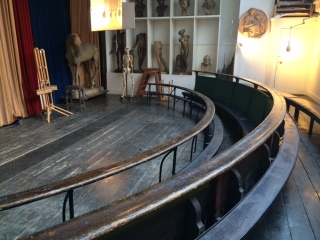
The 200 year old art room at the Royal Academy

skills required to do it well could be taught, learned and developed over time.  Some art schools today teach skills in drawing as Aristotle might have imagined.  How infants learn from the adults around them is through imitation.

But as I look at the art works around my house I often wonder what these philosophers might have thought of contemporary art forms? Imitation has become irrelevant in many ways.  Contemporary Art is more about reaction.  It can engender a feeling or a thought that may trigger a conversation. Imitation might be the seed for an abstract concept but to the viewer may offer a completely different interpretation to what the artist originally conceived. But that’s fine. We don’t seek absolute truth and knowledge like Plato.  What we seek is the reaction art

creates in ourselves as we look at a work: the emotion, the appreciation, the transcendence to something outside of the ordinary. And yet embedded in our everyday lives at home as we surround ourselves with contemporary art.

Perhaps Aristotle saw that capability in human understanding. Whilst he didn’t speak much about individual artistic expression he appreciated that skill and knowledge was required and that we could learn and understand about life by looking at art.

That’s not to be dismissed.

Portrait of a group as an individual

It’s been a longer summer recess from blogging than I imagined – or wished for! Though that shouldn’t be mistaken for inactivity . The opportunity to step back, assess and think can be the most active and creative of tasks and all too often swallowed up by the process of daily life.

hong-kong
Simon Lee Gallery

One of the highlights for me in the last couple of months was an opportunity to talk to Ceri Hand, Associate Director (Institutions) at the Simon Lee Gallery in central London.  With 25 years of experience working in the art world  as a curator, arts manager, director, commissioner, producer and fund raiser (to name a few!), it was a perfect opportunity to ask how she saw The Collective. With our own method of collective buying and dialogue with artists , our interaction with galleries and yet our existence outside the gallery programme, gaining an experienced outsiders view on how we fitted in to contemporary art thought and practice was what I was hoping for. I wasn’t disappointed.

The Collective’s first meeting with Ceri was as Director of the Ceri Hand Gallery  where

145_img
Mel Brimfield: On Board 2010. Owned by The Collective

we purchased Mel Brimfield’s “On Board” [2010] A bold and evocative print with suggestions of an antiquated notion of women and domesticity (or death of!) that has inspired many conversations amongst visitors and viewers in our homes.  Watching male members of my household iron always evokes an image of this work in my mind!

One of Ceri’s first remarks about the Collective was around the “the ethos of the collection itself” where the collection is in “the hands of multiple people in multiple houses who are having multiple conversations with multiple ideas and voices around one piece of work”.  This principle is then in dialogue with other works which creates an exciting dynamic that artists would naturally support.  “If one took a snapshot of an individual household at any one time and put it alongside the snapshots of five other household interiors, the kind of dialogue that is generated would be fascinating” 

1468679918-008-bedwyr-williams-theredlist
Bedwyr Williams: OO/HO model lamp post 2012. Owned by The Collective

Finding new audiences and expanding discussions on individual artworks can also stimulate a wider discourse on contemporary art and culture more generally.

I was interested to find out from Ceri what her experience was of the way in which individual collectors interacted with artists whose works they purchased?  Were they buying for investment? From favoured galleries and curators? Did they rarely meet the artists, or was there potential for a deeper interaction, which is so favoured by the Collective where we regularly visit artist studios? “Everyone is unique”, says Ceri.

Ceri explained that there was a lot of education and discussion by the gallery curators around an artist and their work, and some collectors do form very deep relationships with the artists and continue to buy their work through their careers.  For others however it is not about wanting “to know” the artist but about the significance of the work to the buyer, who may feel that by meeting the artist that “meaning” might be altered, and so shy away from any interaction.

This was a fascinating insight and a reverse process to many of us in the Collective.  As we are a mixed group of people with different tastes the purchasing panel may buy work that is not to the taste of every member.  By meeting and talking to the artist that perception often alters, combined with living with the work on a day-to-day basis so that what starts out as “unlikeable”changes to “likeable”.

The Collective is great in the way you encourage each other to look again” says Ceri  “and exciting from a gallery’s perspective in terms of bringing you in to see different works”. For Ceri, working with museums and institutions, any opportunity to open up conversations to a wider audience is a top priority.

89_img
Susanne Treister: Obama with 9 eyes 2009. Owned by The Collective

I was very interested to hear Ceri’s view on our “what next” dialogue for the Collective and possible suggestions for a new direction.  Ceri felt that as supporters and investors of contemporary art thought and practice through The Collective that we have become, as a group, “patrons”. Viewed in this way we should look to other ways of making contributions that could support arts organisations and widen the audiences and dialogue around works, whether emerging artists or entry works from known artists that are rarely covered.

Loaning (or even donating) some of our works to regional galleries where there is less resource for acquisitions would be one such route.  At the same time programming talks around such loans would be a way to expand the idea of “the Collective” and draw on new regional audiences.  Partnerships with arts organisations where we could support research ideas in different areas through our own acquisitions was another idea (e.g performance art, women artists).

Despite the short amount of time I had with Ceri, it was idea intensive and very thought provoking.  I arrived quite drenched and anxious (thanks to a cloud burst at the moment I walked out) but left both dry and inspired by our conversation.

My favourite take away remarks was her view that the Collective was “a portrait of a group of people as individuals and as households” which held great potential with many multiples for an extended dialogue around art works.   How true.

Many thanks to Ceri Hand.


Looking in from the shadows

IMG_0802The last 10 days of political turmoil in the UK has plunged us in to an unprecedented period of apparent chaos.  We’ve ejected ourselves from our European counterparts, hurled our two main parties into leadership uncertainty and contest, highlighted major divisions across the nation and left 75% of our youth who voted for “Remain” feeling betrayed and deprived of a future they thought would look very different.  With three young voters in our family alone our collective shock on that dismal Friday was palpable. We tried to understand the enormity of the news as we heard it.
“What’s happened?” was a question I was asked by friends outside of the UK.

It was difficult to answer, and I don’t intend doing so now. Tireless analysis has filled our ears and heads, outpourings of all kinds continue to emanate from our national news channels. The day after the result I missed my bus stop transfixed as I was by the haemorrhage of opinion flooding through social media.  I was well on my way in the wrong direction before I even thought to look up.

Reactions in the art world are no different in their divisions –  “business as usual” say the global collectors and auction houses – whilst acknowledging volatility in the financial markets may cause some fluctuations and a “few jolts”.

“the world isn’t moving backward, ….. We are moving backwards. Yesterday little England got a lot littler” said artist Ryan Gander to Artnet news

Artists, curators and galleries have shared their views and worries publicly just like everyone else – additionally concerned by the possible threat to the flow of European grants that currently arrive in the UK for the arts.  European students help support our higher education establishments including the art colleges – with £3.7billion worth of revenue generated by EU students every year.

Still too many unknowns to know what’s next.

IMG_0808
The Life Drawing Room at the Royal Academy of Art, London

But a visit with various Collective members to the Royal Academy of Arts to see the final show of this year’s selected group of 17 post graduate students was a welcome reprieve from the ever gathering clouds of this unusually gloomy summer.  It was refreshing to see a slice of some future emerging artists, wherever their journey might take them.  For me, the video and animation was the highlight , and stood in stark contrast to the the 200 year old life drawing room that we stumbled across in the middle of the exhibition rooms. A great insight in to the long history of the Academy, now interwoven with techniques that bridge drawing with the digital age.

Elliot Dodd’s surreal animated heads on human figures having a conversation in their BMW in his 4K digital film Limpid and Salubrious, was so transfixing that one felt almost absorbed in to it.

Because of the need to make time to watch film, it is always difficult to see how they can best be seen and appreciated in a domestic setting for a Collective group such as ours. Art on walls or free standing sculptures you can absorb and walk around as part of daily living- but not so easy with film.  Nevertheless there was an attraction that I found compelling.

Two friends, two curtains – Molly Palmers two channel HD video with sound had me sitting in the room watching for a while . Not easy to understand, I didn’t think that was the point, but more the connection with movement, colour, shapes and sound and how they interact together on screen for the viewer to interpret as they will.


Gery Georgieva was my other top attraction with her multimedia installation. She uses her own Bulgarian roots to explore cultural identities and pop cultures, often using herself as the main subject on which she builds her creativity.  The main projection spilled over the screen to the wall behind whilst two other screens displayed different topics including the view from behind a windscreen as it was being washed.

Finally I must mention Kira Freije’s installation A Rapid Succession of Noises That You Confuse For Danger – in fact a room full of steel sculptures and structures, that had an eerie and sinister quality despite the bright white walls and fine steel parts.  Particularly intriguing was the kneeling Holy Woman  which brought a smile to my face as I thought of the life size sculptures we’ve had in our house and the reaction they invoked. I tried imagining how this might go down….sitting with us in the living room..


There was more, so much more from these 17 Royal Academy students.

As we left the academy at the end of the evening and headed off to have a drink I knew what the topic of conversation was likely to be.  But at least I felt some restoration of spirit as  I looked in from the shadows at some bright futures.


Tales of unexpected moments

It all seemed to happen in the last week of May .  A visit to the opening of an exhibition in a small gallery in Hoxton, east London and a studio visit to an artist based in south London.  Both quite different, both centred around sculpture, and both memorable for different reasons.
Bx5gLxxCEAA6x6dIf you’ve ever wondered why gallery assistants accost you, with degrees of politeness or hostility, when they spot you carrying bags whilst visiting an exhibition – the first unexpected moment will almost certainly answer that question for you once and for all.     The gallery space in east London that we visited occupied a small basement floor beautifully laid out for the current exhibition showing a sculptor who worked in mixed mediums.  It was a first solo show and the combination of unusual found objects separated from their original purpose or identity and reconfigured with the artists own “additions” – often made from a different medium – was both intriguing and stimulating.  Each sculpture told a mixed story of old and new recreated to present a quite different concept from the objects themselves.
But then it happened.  Amidst the murmur of conversations and people, small movements and manoeuvring as the space filled up with visitors, the air was punctured with a heavy sound of smashing glass on the concrete floor.  The gallery was silenced in an instant.  We didn’t need to turn to guess what had happened – it was written all over the faces of those looking in the direction of the noise – “thank god it wasn’t me!”.    An accidental swing of a shoulder bag had unseated one of the sculptures and brought about its noisy end. A corporeal unwinding. As I was leaving the exhibition I heard a visitor talking to the artist “You must have been so angry?” , “no, I wasn’t angry , not everything works out”.  An unanticipated and forgiving moment.

A studio visit is always unexpected in terms of what you’ll find- and is probably one of the

IMG_0756 (1)
ASC studios

most rewarding aspects of what we do as a Collective.  A rare opportunity, not just to view art but to get beneath it to the creator and learn more about how, why and what motivates them to make the art they do. – and in the space they do it!  So it was we went to see artist Tom Dale at his studio in south London.  All six households turned up for the occasion.

Tom calls himself a Sculptor, although video and digital photography feature in his collection in addition to the objects. There doesn’t seem to be a restriction in what materials he favours and uses, or what size they are as long as it “creates a reaction”.”What I’m

IMG_0766
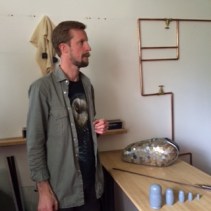
Tom Dale in his studio in south London

interested in is creating an immediate and visceral response so that you ask yourself – why do I feel like this?”   Tom likes to steer away from over intellectual explanations and prefers that you ask questions – both of him and his works – mainly because his art “begins with an idea I have to solve – a question – and through the making of the work I try to answer that question”.  The result may be that it encourages you to ask more questions

TDALE_ballwithwheel
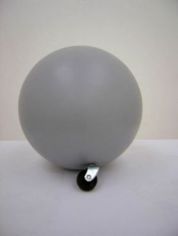
Ball with wheel by Tom Dale

as the viewer.  Tom’s openness to his approach is refreshing and his down to earth way of speaking engaged us all as he went through his works past and present (and not all of them in his studio).  In 2005 he wanted to see if he could improve on the idea of something that was essentially  a “perfect “sphere and added a castor wheel from a chair.  In so doing he made the ball useless – trapped in immobility.  “it might seem banal” says Tom”but there was a specific thought behind it”.

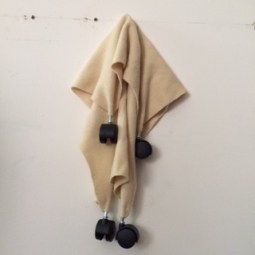
With castor wheels in mind there was one work on the wall of his studio that had already grabbed our “Collective” attention.  Called “witness” it consisted of a small off-white blanket with four castor wheels attached.

IMG_0767
“Witness” by Tom Dale

“Only in the moment of being hung does it look like a figure – on the floor it would collapse without

substance” says Tom. Just an ordinary blanket – with wheels. Can that ever be ordinary, I wondered? We all had different interpretations from quite dark thoughts of faceless and threatening figures to totally playful images of animated  sheep !  “I like the idea of objects having a life of their own” – and this one certainly did.

IMG_0759
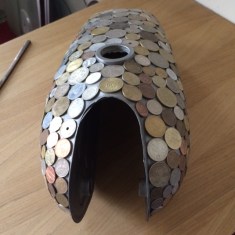
Work by Tom Dale

Copper pipes and taps giving testimony to a networked and connected world (that could nevertheless be switched off) , grey painted Russian dolls representing interconnected world currencies (that could disappear inside each other) and redundant coin-covered motorbike petrol tank covers provided a remarkable afternoon of unforeseen highlights .

“I make lots of work – but not loads.  Ideas take time and often have a slow release”.   Just as living with art allows us a slow release of acknowledgement and unexpected moments of reflection and pleasure over time.

Thanks Tom Dale.


When the conversation turns to “what next?”

98_img
Joy Gregory, Handbag,2003. Owned by the Collective

When we meet as a Collective group, one thing we are never short of is conversation. Is it critical engagement? No, not always. We come with different perspectives and from different professional backgrounds so there is always plenty to bring to the table, bound as we are by our common goal of buying and sharing contemporary art for domestic spaces.

But after 14 years of existence as a Collective group and a growing reputation, there was one conversation that we hadn’t yet had, and was starting to surface amongst us: where do we go next?

Having acquired over 60 works during the course of our fourteen years of existence– there was a growing question of capacity. Walls and spaces are finite in our homes, however much we love the art,and our homes could well get smaller as children move away, not bigger. Storing some of the art would mean not seeing certain works and seem to defeat the purpose of acquiring new pieces if we were hiding some of the old. Added to this artists love the idea that their work will always be on display in one of the houses. And if we were to start selling, which ones?

So on a cold March Saturday we met in town in a small library room for the sole purpose of

124_img
Peter Pommerer, Giraffe with blue eyes, 2000. Owned by the Collective

discussing “what next”? Perhaps there wouldn’t even be a “next”, but a “winding up”? Was that a possibility? Not all collective groups that have started have continued as long as we have, and sometimes the commitment combined with life’s demands require flexibility and a different approach.   We have certainly never proposed that our approach should be a lifetime set up.

As this was potentially a momentous step in the history of our founding Collective, I decided to record the session with audio, whilst Theresa kept notes. This blog is based on those two sources.

Going round the table of the 12 members present it became clear very quickly that we were all agreed on a single point: far from wishing to wind up we wanted to continue as a Collective group – but we were in need of new ideas and a degree of reinvigoration – possibly a redirection.

mel-brimfield
Mel Brimfield, On board, 2010. Owned by the Collective

There were certainly pressing practical considerations: a large number of works, limited capacity in our homes and the reality of assembling twice a year with all the works, some of which required van hire because of their size.   Getting to private views, art fairs, auctions and studio visits appeared to be getting increasingly hard to achieve with the same few members always attending, and the buying panel system was starting to be less workable. But this should not be interpreted as “nothing happening”. On the contrary in the last year we watched a live art commission unfold in our homes, attended the Drawing Room’s excellent biennial auction, gave a talk about the Collective at Sluice Art Fair, visited Art Rotterdam and acquired three new works. Hardly a sign of disengagement!

Every member contributed their thoughts and suggestions and by the end common themes and ideas started to emerge:

  • we needed a professional valuation of the entire collection to assess what the possibilities were of selling works or loaning to other groups.
  • Reinvigoration – focussing more on the experiential rather than physical works e.g more live art?
  • Engage a curator for a fixed time to take us in a direction that we had not yet considered?
  • Support an artist residency or internship for an emerging artist or student?
  • An educational approach with more international visits and following up on international connections we are now creating?
  • Organise an exhibition of our entire collection – combined with a launch of an artist residency/internship/bursary/curator?

One of the more contentious issues was the idea of selling some of the works, some

Microsoft Word - Document2
Untitled, Chris Ofili, 2000. Owned by the Collective

members recognising the importance of the history of the group and where it began, rather than any monetary consideration.   But not selling and generating some cash may limit the potential of any new initiative or direction we decided to go in. That conversation needed more time.

So where did the discussion end? We hurried to consult our calendars realising the need to meet again to continue talking.

As we got up to go we all recognised an important step: The conversation had begun and some kind of change was now inevitable for a founding Collective we all wanted to keep.

What’s next ? Watch this space!


The Invisibility test

looking-now-seeing-past
“Looking and seeing” Frits Ahlefeldt (1966)  Denmark.


A couple of months ago I wrote a blog about how the constant exchange of art works through The Collective meant that what’s on our walls would never become “invisible”. Instead, our domestic spaces assumed a more dynamic nature that changed in aspect and feel every time we had an “exchange”.This made us pay more attention to their detail, even when you have had them before, as it was more akin to a new acquisition “with a certain familiarity” every time they returned to your home.

The idea of an art work, or any item on a wall, becoming “invisible” because it remains in the same place for many years was put to the test recently, albeit inadvertently, in our own house.

We have a large screen print by a well-known artist that is very distinctive. I am particularly fond of this piece though it is not part of the Collective’s Collection. Apart from being a wonderful work, it has a history and memories associated with it that hold great significance for me personally.  Every morning as I eat breakfast in my kitchen I can see the work on the wall, through the door in the next room.  And every morning it reassures me and inspires me, as I look at it and see it there in its particular location. I never tire of looking at it.  It’s been there for years and I watch it change with the different seasons as mornings get lighter and then darker ,and through all the associated light changes that come with our weather and hit our dining room in the morning.

The work needed reframing which we had discussed on numerous occasions and as Tim knew the appropriate framers I was going to leave it to him.  Time passed and still we hadn’t managed to do it and now it also needed some conservation work.

This year, on my birthday, Tim presented me with what appeared to be a large art work, all wrapped up as it was.  I was excited! When I opened it, it was the very same screen print that was on our wall in its usual place.   How had that happened?  Only then did I really notice.

Unobserved by me, Tim had taken down the original, had a good photocopy done, reinserted it in to the old frame and taken the original screen print to the framers where it was now presented in a brand new perfectly finished frame, fully restored and even more of a spectacle than before.  I was stunned – how could I have not noticed?

Only once had I speculated that the colour looked different but thought it was nothing more than a trick of the eye with the particular light of that morning.  I had ceased to observe it properly, but just viewed it from a distance in its rightful place.  It’s detail had in fact become invisible and what mattered more was that it was just “there”.

There is an established science around “familiarity“and psychologists have discovered that there is a “happiness directly correlated to how many thing we are familiar with”.  But why are familiar things more “likeable” ? Are our brains lazy or is it that “familiar things make us feel more comfortable“?  The answer is “yes”,they do – they reassure us, provide landmarks amidst all life’s uncertainties and anchors in our domestic  spaces.  In this case the anchor was the art work that never moved from its place. The trouble is that in the process of making us feel more comfortable our brains stop to really notice and a layer of “invisibility” is created.  We only really sit up and see when something changes significantly.  This is of course why the the constant change of the Collective art works provide so much stimulation and interest because we, and all visitors to our houses, have grown to expect change and notice more readily when they see the new or returned art works.

I’m still astonished I failed to notice the substitute, but it struck me how true the assertion was that familiarity creates invisibility. Perhaps the difference between looking and seeing.

When did you last ‘see’ a familiar object that you look at every day ?  You might learn something new!


The Collective go to Art Rotterdam

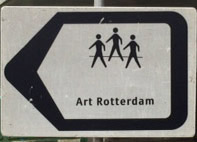
February is a cold time of year to visit anywhere in the northern ar signhemisphere but a VIP invitation received by The Collective to visit Art Rotterdam was not going to be passed by, whatever the weather.  Although not all of us were able to go, it was the first time that a sizeable number of us made the trip. Kicking off a season of European art festivals Art Rotterdam is now well known for the opportunity it offers to see young emerging artists with over 100 galleries occupying the vast Van Nellefabriek building, an impressive Unesco World Heritage site set in a bleak landscape on the outskirts of Rotterdam.

Art Rott. building
The Van Nellefabriek building in Rotterdam where Art Rotterdam was held

There was a perceptible excitement and energy inside the Fair and although there was a good proportion of commercial galleries mixed with not-for-profits, there was not the same sense of wealthy collectors and cash machines that you find in some of the more established Art Fairs. This was largely about new visual art, new talent and ideas and it felt good to be there as an individual and as a “Collective”.  I enjoyed being surrounded by the sounds of Dutch, Belgian and French to name a few, although English was always an option when you needed something!

Exhibits included video projections, installations, sculptures as well as the more traditional painting, drawing, print and photography.  The deeper you went in to the fair the more interesting it seemed to get, and it was easy to forget your way back through the labyrinth of walk ways, spaces and ideas to our various meeting points. What really struck me was how busy it was on a working day – the constant throng of people testimony to the popularity of this fair, the commitment and engagement with art and new talent. Yet you never felt overwhelmed by it or crowded out by it, as each gallery space offered its own intimacy.

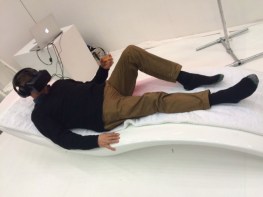
ART RotterdamCertainly time to experience an audio sculpture in the RAM Foundation stall where you could hear moving stories told by migrants while you sat on the sculpture, or some virtual reality in the new projects section where you could exchange your body for the opposite gender in a parallel world.
Art Rotterdam 2
An opportunity to experience a virtual reality with a different body


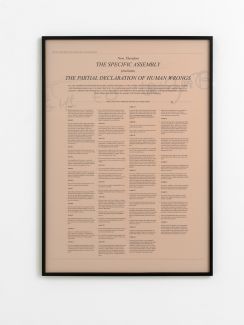
As a Collective, a purchase is always a shared decision, and approval for a purchase must come from more than one household or the buying panel.  Did we come away empty handed?  Of course not. A piece by artists Libia Castro and Ólafur Ólafsson who together with British writer and philosopher Nina Power “deconstructed “the “Universal Declaration of Human Rights” and reconstructed parts of it through a provocative art work and powerful commentary  called the “Partial Declaration of Human Wrongs“.   Given the current global political upheavals and the huge migration and displacement of people across Europe, it could not be more poignant and thought provoking.

1301_2_2012-11-21-Opdahl3178

Example: Article 3:
Everyone has the right to life, liberty and security
of person. The police will let you know when
and where these rights are operative.

Living and working in Rotterdam and Berlin the artists compiled thirty articles for this art work that represent the injustices that exist, despite the “right” that is being proclaimed.

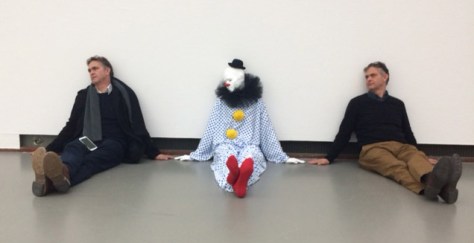
Rotterdam is a wonderful city, a mix of old, new, different architectural eras mixed in with canals, barges and bicycles.  And if we hadn’t had enough of walking during the day at the Fair, there was still time to visit the  spectacular Boijman’s Museum in the heart of Rotterdam where the opening of Ugo Rondinone’s show was taking place by night. An intriguing piece consisting of forty-five life-size clown sculptures was displayed across the expanse of the 1500m2 gallery floor to mimic, sit with, walk around, absorb and be entertained by in a way that only a gallery allows….

Boijmans 2
Ugo Rondinone’s work “Vocabulary of Solitude” Boijmans Museum, Rotterdam

and only experience can tell….

Boijmans 3
Double vision- Collective members enjoy Ugo Rondinone’s work, “Vocabularly of Solitude” Boijmans Museum, Rotterdam

Collectively called “Vocabulary of Solitude” the clowns describe a solitary and contemplative day at home.  And yet the experience of seeing them seemed a far cry from that description.

Thank you to Art Rotterdam for providing so much pleasure at the Fair.


The Returns


Bobby Dowler 3
Odd painting 1 (2009) by Bobby Dowler. Owned by the Collective

When I famously opened my mouth in shock horror on national TV during the Culture Show‘s short piece on The Collective my disappointment was obvious to see. Why was I disappointed?  Our household’s bid to have The Collective’s new purchase, Bobby Dowler’s Odd Painting 1, was rejected by our fellow Collective members in favour of another household during our twice yearly “exchange”. It was a fair vote and as a Collective member you have to take the disappointment with the excitement in the knowledge that your turn will come – just not this time. Patience is a virtue and the reward is all the more sweet when your favourite “returns” come home.  That moment came just before New Year.

Buying and sharing art work between six households does mean that most of what you are exhibiting in your home (though not all) is never permanent.  I have always seen this as a benefit, because the art works don’t have the chance to become “invisible” – merging in to wall or floor where they might assume more of an identification feature of your house – part of the decor.  If, however you are changing the works every six months that process of “merging” never happens.  Family, friends and visitors notice the changes, come to expect them even, and the walls retain a unique quality that is dynamic, almost living, as they are constantly re-energised with changing art works.

The downside is the sense of “loss” of your favourite piece(s )every six months – and

Bobby Dowler 1
Odd Painting 1 by Bobby Dowler. Owned by The Collective

sometimes you do feel a real sense of loss in something that may have brought so much visual and emotional pleasure within your house.  But when you do get it back you see it as if it is a new acquisition again, particularly if the gap has been a long one.  This was certainly true of Bobby Dowler’s Odd painting 1.  The thrill of getting it back, and having it up on the wall again, immediately changed the room bringing a new vibrancy and spirit.  Family members noticed it immediately:

I like that one – we haven’t had it for ages

Is that the one with the chewing gum on it?!”

Their friends noticed too, and being the Christmas break, all visitors passing through the house commented.  Some of them had seen it before, but the return had made it much more visible again.


BD close-up
Details from Odd Painting 1 by Bobby Dowler. Owned by The Collective

Bobby Dowler is a south London based artist, represented by the Hannah Barry Gallery in Peckham. Odd Painting 1 is made from found canvas, bits of old book pages, chewing gum and scraps found on the streets of Peckham and woven together with lots of colour.  Based as we are in south London this has added appeal in our household- “it’s from our own back yard “(or very nearly).  It’s a big work for a domestic space and certainly bigger than anything we had bought previously or have bought since, in terms of space occupied on a single wall.  It even requires separate transport to move it every six months as none of us have cars big enough to put it in.  It’s a “degradable” art work in that it will deteriorate with time, unprotected as it is on its found canvas.  But it is still very much in tact, cared for and valued across all the households – like all our works.

Most people will associate “Returns” with one or more products being sent back because they are the wrong kind, not working, damaged or no good – and most definitely “not wanted”.  For Collective members “Returns” can be one of your most treasured and valued works, a personal response that makes them all the more special for having them back. Viewed with a renewed energy it’s as if you are seeing them for the first time but with a familiarity akin to a homecoming.


Own worst enemy


OedipusSphinx01-1
Oedipus and the sphynx: in the myth King Tiresias said he was “his own worst enemy” bringing destruction on himself

Have you ever been told that’s what you are? Your own worst enemy? Do you already think that’s what you are?  And what does it mean anyway? That because of “being you”, you’re responsible for all the ills in your life? It’s seems a harsh form of characterisation and yet one that Greek myths and Shakespeare alike delighted in using for their tragic heroes, and that history recounts again and again. Or is it simply an explanation for something or someone different, simply at odds with their environment?

What I’m actually referring to is a suite of three performances created for the Collective by performance artist, Jefford Horrigan and curated by Rose Lejeune under the group title of “Own Worst Enemy”. Read in to it what you will.

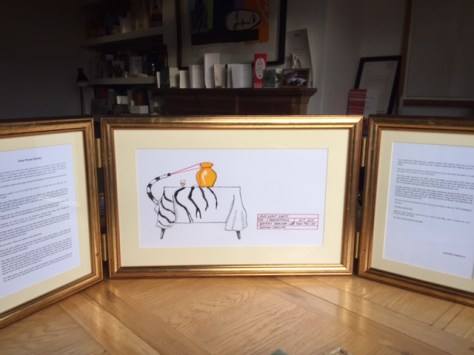
You may remember that earlier this year I wrote about a visit to Jefford’s studio in London’s east end with a view to commissioning a work with him, as part of a wider research project of Rose’s on the process of collecting less object-based art and the experiences gathered during the course of that collecting journey. The commission would comprise performances in three of the six Collective households and apart from the more experiential legacy of the performances themselves and the memories they would invoke, there would be an object – a triptych drawing for us to add to our growing collection.

The visit to Jefford’s studio did nothing to help visualise what might be coming our way- but it did wonders for generating an overall excitement for the project! What I do remember was him telling us that he liked “to create atmospheres” and that “It’s more about presence than the thing itself, and it can belong in its own environment”.  He clearly used household objects – particularly furniture – to create remarkable transformations in to “something other“.  Jefford responds to the environment he is in when creating his performances and for that reason he visited all six households in order to select which three he would perform in.  It wasn’t ours (sadly) – but he made three good choices – three individual living spaces in west, south and north London.

The first performance, aptly named “Passenger” was on Collective member Ben‘s boat – an unusual transformation in its own right from Dutch working barge to private dwelling. The performance filled the cavernous space with the boat’s overhead beams cleverly included as an additional prop.

Jefford 1
Passenger: a first performance by Jefford Horrigan commissioned by the Collective

The items of furniture used and the artist himself, transformed as they were in to a bird like creature, evoked a sense of flight, travel to distant places and previous eras. Stunned in to a silent reverie of what was unfolding before us a solo tenor further transported the audience with an unexpected aria from Mozart’s The Magic Flute. Magic it was.

The performance finished, the space was filled with animated conversation on interpretation, understanding, themes, amazement and excitement! Nothing we saw was expected or anticipated.

In his book Keeping an Eye Open Julian Barnes reminds us that when it comes to art,

we remain incorrigibly verbal creatures who love to explain things, to form opinions, to argue”.  

How true! Opinions differed hugely on the meaning of this first performance but one thing was certain: even if we were stunned in to silence during the performance “it is only a short time before we want to explain and understand the very silence into which we have been plunged.”  Jefford in his quietness allowed us to continue that exploration unabated.

Jefford 4
Threshold: a second performance by Jefford Horrigan commissioned by the Collective

The next two performances, the Threshold and Own Worst Enemy were all separated by a week, in living spaces that grew smaller in scale, each with a singer as an important element and all equally transformative in their nature – chairs, tables, carpets and tigers – with Jefford at their centre facilitating the transformation, creating an art work as he performed and plunged us in to silence in our own domestic spaces.

But if we didn’t agree on meaning we could agree that our own response to watching the performances is what mattered most.  How we engaged as individuals and with the artist,

Jefford 5
Own worst enemy: a third performance by Jefford Horrigan commissioned by the Collective


how we interpreted , how we reacted on an emotional level and what we drew from it, was and is our reality.  How we now share those thoughts and feelings is up to everyone of us and what memories we hold and pass on.   The performances can’t be repeated, but the memories can be remembered and retold both within and outside of the Collective group.

I mentioned in my blog on a previous performance art commission, Home Suite, that it remains the most discussed and referenced piece the Collective has ever purchased and yet we have no physical legacy in any of our homes that the work ever happened.  This time we do.

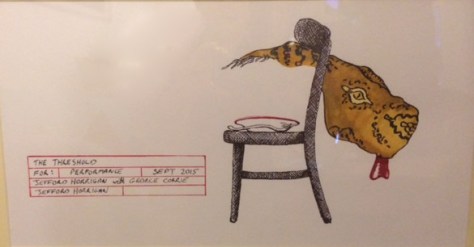
With each performance we have a drawing by Jefford and curator Rose Lejeune delivered all three to us just before Christmas. So, as we share the works between the households in time to come, we can retell the stories of the performances to new viewers for which the drawings speak for themselves in a new way, equally valid and equally valued.

If this is my own worst enemy, I welcome it heartily.

IMG_3332
Drawing from “Own worst enemy” : the final performance by Jefford Horrigan Oct 2015
Jefford 7
Detail from a drawing from the performance “The Threshold”   by Jefford Horrigan Sept 2015


Performance publishing: prints and empty spaces

Driving in to a lorry park in what felt like the dead of an autumn night wasn’t where I expected to be. “But that’s where the blue dot says we have to go” – referring to the directional bible on my illuminated screen.  Not deterred by the lorry park I insisted we had to go that way, despite all advice to the contrary!  It was the dim light through an open door at the other end of the stationary lorries that made me think this must be right – and knowing that this particular artist was drawn to large empty warehouses!  We had arrived at the V22 Excelsior Works in Bermondsey where artist Maurice Carlin was showing his latest performace publishing work.

Maurice Carlin: Performance Publishing, V22 Excelsior Works Oct 2015

Maurice explains his work as an “exploration of structures and processes” – which is exactly what it is.  Maurice maps out the floor of the cavernous warehouse through a series of print “rubbings” that reflect the surface of the floor below, each one quite unique as the floor is never uniform and so varies in tone and colour to reflect those anomalies.  Using the standard colour printing process referred to as CMYK (cyan, magenta, yellow and key [black]) and standard sized sheets of paper (A2 or bigger) he pulls a screen printing squeegey applied with one of the rich CMYK inks over each sheet.  As he works his way across the floor over his herring-bone placed sheets he makes a decision as to which ones he will apply the current colour to with his squeegey, in a purposeful and methodical way. The process is very silent, save for the bang at the end of each application as the squeegey is hit against the floor and amplified across the warehouse. Where he lands seems quite arbitary to the viewer, so that one sheet may have one layer and an other a multiplicity of layers. Carlin’s “process” references a very ancient Chinese publishing technique that used stone or brass in a similar way to make official records.

Maurice Carlin: V22 Excelsior Works. Oct 2015
Maurice Carlin:  print based installation at V22’s Excelsior Works in South Bermondsey, London

It’s an exhibition that explores a published record of the bulding’s floor which in turn transforms the large grey empty space in to a new environment with a colourful floor map.    It is mutli-layered on many fronts with a combination of Maurice’s own performance to create the prints with the CMYK printing process, the mixture of historical record and ancient practice set within a modern industrial space to create a contemporary art installation.  It’s both simple and complex – a layered visual “story”.  Is an art work ever “just an art work”?

Maurice doesn’t confine himself to the physical space he is working in. He constantly communicates the unfolding story through video streaming and daily live broadcasts via google+, socialising the concept and pushing outside his physical boundaries to a virtual reality for a more global audience – with whom he can interact. The slight whine of the video monitors are the only other audible sound  – a reminder of this external transmission. He has more than one webcam set up around the large warehouse so different perspectives are constantly available.  It’s this combination of physical and digital, ancient and modern that combines to create an art work that is compelling and intriguing.  The more you understand it, the more fascinating it becomes both as a whole and as individual art works.

Maurice Carlin: print based installation at V22’s Excelsior Works in South Bermondsey
Maurice Carlin: print based installation at V22’s Excelsior Works in South Bermondsey, London

Meeting Maurice for the first time was the result of an invitiation to join a discussion group on “shared ownership” where we explained our experience of The Collective and how we worked together buying and sharing contemporary art.  Maurice himself wished to explore his plans for the distribution and shared ownership of 135 relief prints from a 3-month live art performance  within a 750 sq foot old furniture warehouse in Salford, using the same techniques we witnessed in Bermondsey.  When we met Maurice again he explained his latest plans for the project and how “temporary custodians” were being sought who can invest £1000 for a ten year lease of each print. It would be

an alternative to a simple act of ownership over a work of art, custodians instead become participants in the life of the artwork. They are invited to help us explore methods of sustainable artistic production and an alternative means of ownership through their act of shared, distributed ownership. This collective investment will support our creation of a new and permanent space devoted to large scale works and collaborations at Islington Mill.” 

At the end of the 10 year period, the temporary custodians will be invited back to discuss the future of the relief prints, and possible ownership.  In the interim, the collective investment of all the custodians will go to a project that helps other artists.  It was difficult to find a reason not to take up this particular art experience – right at that point.  But as a Collective member the decision did not just rest with one household – it would be a discussion in itself, and a decision by the purchasing panel.

And what would we be considering? A print with a rich multi-layered story in its making and a “collective” experience of a very different kind to our own: we would be extending our “custodionship” to a conversation beyond the boundaries of our own homes. We left Maurice as he continued to publish his floor prints and slipped out and back through the lorries, with plenty to think about.

Maurice Carlin: print at Excelsior Works
Maurice Carlin: print based installation at V22’s Excelsior Works in South Bermondsey, London

Stories about The Collective Founding group – a group dedicated to buying, collecting and sharing contemporary art in the home for the last twenty years. Written by group member, Marie-Louise Collard, it is based on personal experience.