Category Archives: The Collective blog

Did the children get enough?

Sara awan
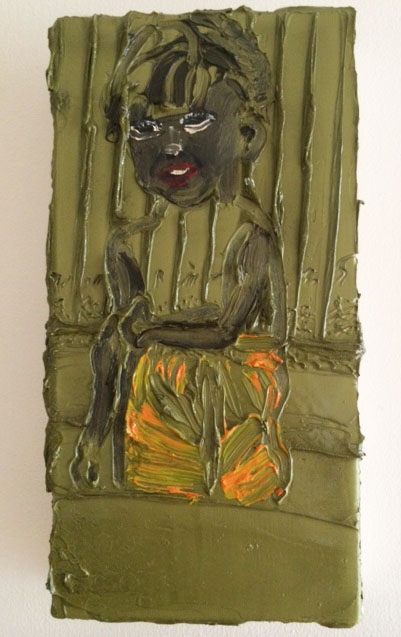
Young Girl by Sara Awan. Owned by the Collective

When they were very young we took our children to see exhibitions.  In a country where it rains more than the sun shines, it was a good place to take them: it was indoors (though not always), there was space, usually not too many people, interesting shapes and colours to look at  (even if they didn’t understand) and a chance for the adults to feel “adult”.   There were always those unforgettable moments when your child was the one lying prone on the gallery floor, legs kicking and murmured explanations of “they just don’t want to leave” , or the disappearance under a no-entry cordon out of sight, setting off a train of panic that could only be made worse by the sound of an alarm going off because an identified visitor had touched an artwork.  We remember, even if they don’t.

Occasionally a particular exhibition or piece of art would mesmerise them and they would talk about it for weeks, later becoming absorbed in to family folk lore. The more strange, the better – Richard Wilson’s 20:50 oil installation at the Saatchi Gallery being such an example.  Creating themselves was inevitable. A house filled with crayons, paints and pens and a fridge pasted with the latest master pieces that extended beyond the magnets and crept up the walls.  It was their space to fill as we all pleased.

As they grew older the master pieces became replaced with photos of their landmarks, more refined master pieces and holiday fun.  When we mentioned the word “exhibition” the room would miraculously empty as they informed us of previously arranged commitments that couldn’t be avoided, friends waiting for them and more homework than would possibly allow them to go out at that point.  So we would make arrangements and go on our own.

But then something better happened.  We started to buy art and bring it home to put on our walls. Six households buying and sharing art collaboratively between and in their own homes. The Collective had arrived.

To the children it meant periodic gatherings (“exchanges”) where they could meet up with their cousins and friends and eat cake whilst the grown-ups looked at art.  They ran round the house playing hide and seek and occasionally voiced an opinion on what their favourite piece of art (and cake) was “can we take that one home this time?”. Cake and painting.  Exchanges were social occasions for all ages.  We encouraged interest and opinion in what works we chose to bid for and take home for our walls, even if it fell on deaf ears.
95_img
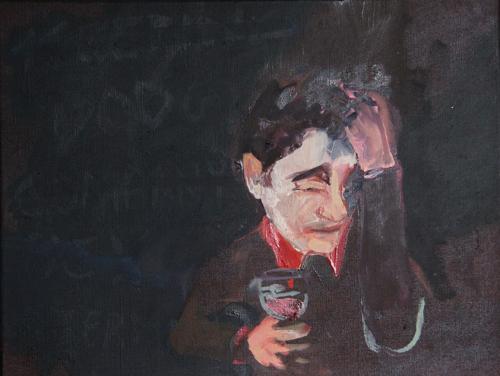
Keeping Dodgy Company by Michael Ajerman. Owned by the Collective.

As they grew older our three children welcomed their friends in to our house, as we would want them to. Their friends accepted we had lots of art on our walls and even expressed their opinions – noticing when things changed “oh, don’t you have the one with the circles any more?” , “What does this one mean?”  Our own children often reacted strongly: “I’m not eating at the table with that drawing looking down at me!” ,”That work shouldn’t be in here, or my friends won’t come round”.  But they did come round, and their friends either ignored the art or engaged in conversation with us, asking questions about a particular piece, “everyone has an opinion” muses our eldest son, “there’s always something to say“.  A few started to look for the changes and grew to expect new works over time pointing out anything new.  “It’s like a feature of our home”, our youngest son pointed out, “you live with it, but it doesn’t mean you always like it”.

At Christmas time when families gathered the cousins delighted in entertaining us with an annual sketch of The Collective “in action”, how we engaged and how we purchased art, bringing us to our knees with laughter, but only because they knew what an important part of all our lives it was – and that nothing would change that.

beigel3
Beigelbird, (mixed media assemblage and DVD), 2009 © Copyright 2015 Jemima Brown

Recently we acquired sculptures by artist Jemima Brown – life size figures, one of them eerily realistic.  Collective member Jo Eastop described her experiences with it in her house – and her son’s reaction:

“That thing frightened the life out of me!” he said. For the first few days, Beigelbird frightened the life out of me too. Every time I came down the stairs in the morning I jumped. I’d go into a room, become preoccupied with something, forget about Beigelbird, come back out and get another shock. Visitors to the house were dumb-founded and amused. “Oh my God what’s that?” 

A friend of my son’s came over. “Do you like our new art work?” I asked. “It’s not something you actually like, is it?” our son replied.

Living with unusual pieces of art goes a long way to challenging one’s perceptions and understandings of what is “likeable”, child or adult.  When we visit a gallery or an art fair you have reactions to all kinds of art , but you know you can walk away and never look at it again.  Living with art in your home is another experience altogether.  You see it at different times of the day, with different moods, different lighting and can surprise yourself each time, for better or for worse. You can absorb the reaction of those who enter the house. It becomes a relationship, a daily transaction that you can take something from or just accept , even if “like” isn’t the first thing that springs to mind. It’s enough.
I don’t get it, do you?

Sarah Awan
“Hospital Girl” by Sarah Awan, owned by the Collective

In my last blog, Connecting Worlds, I wrote about the influence the Collective has had on my personal career, and how it had initiated a project that would not have been conceived had I not had that exposure to art, artists and a very particular model of sharing and collecting collaboratively.  Far from being just about “art on walls” it was about how, through art and the artists,  one could “see and think differently” in your working environment, how you could question issues that affected us whether on a business or personal level, and how you could engage with a part of your local community .

I’ve mentioned before that the Collectives’ members are from very diverse professional backgrounds  and the idea really came together as a result of friendship, family connection and a commonality of interest in contemporary art (more or less) . This time my story is about Collective member Theresa Nash and how her experiences have changed how she views art, how she works, and what she does in her own time.

When I spoke to Theresa about writing this blog she was eager to share the  “starting point” of her relationship with the Collective.  It was her partner, Chetan Patel, already long term friends with some of the other Collective members, who suggested they get involved.

Theresa described her initial “reluctance” to participate : “I really didn’t get it” “Why art, what was it? – I didn’t know how to relate to it” and she wasn’t keen on the upfront payment to buy the Collectives’ first works! But as Chetan was very interested already, “she went along with it”, nothing more.

Today, thirteen years later Theresa sees “art” as integral to her teaching, her work and some of the creative interests and achievements in her personal life – “it’s had a massive impact“.  She was more than happy to share her story.

Theresa started her career as a nurse and is now Senior Lecturer in Nursing (community and public health) and Enterprise Lead for the Faculty of Health & Social Care in Education at the University of Kingston and St George’s University in Tooting. She is also founder of Heritage2Health, a scheme that aims to develop community-led nursing by working  with those experiencing social isolation and providing them with better access to community and the countryside through specially designed  “events”.  Working in collaboration with colleagues, students, the voluntary sector and the National Trust , “art” in the broadest sense, is an integral part of how Heritage2Health works, and in the project’s success to date.

So how did her relationship with art change? What was it that had such an impact and changed her views?

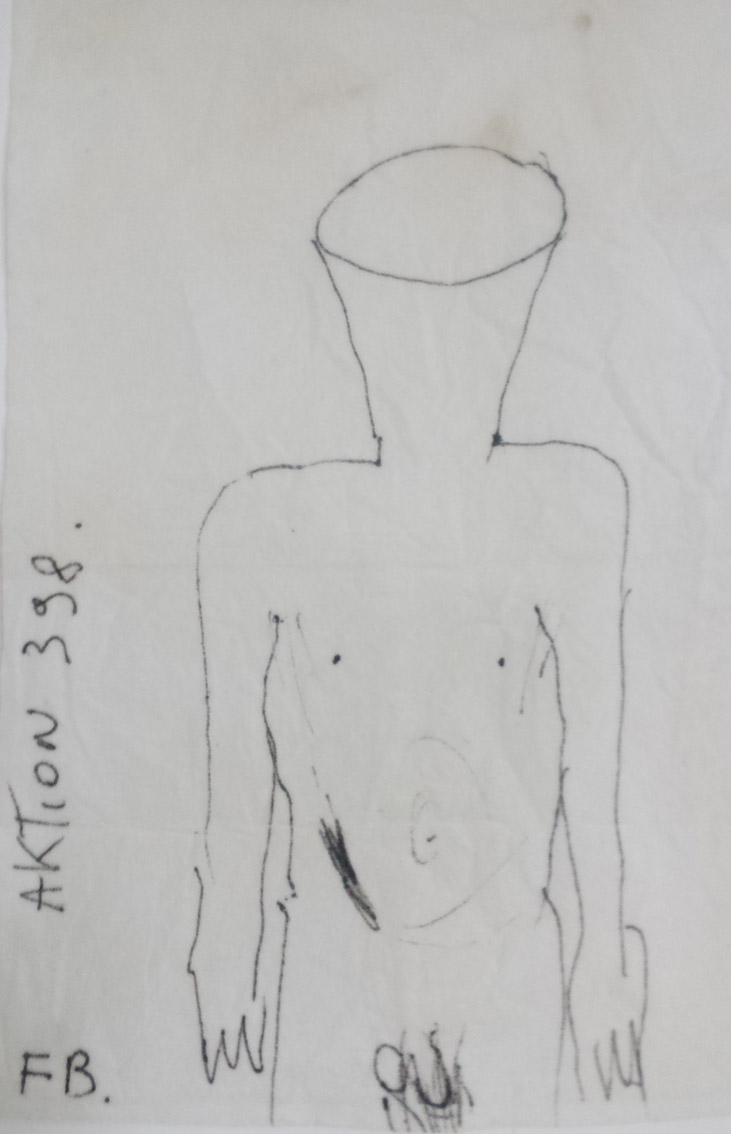
Franko B
A drawing from Aktion 398, a Franko B performance. Owned by the Collective

The first change began when she met with the controversial artist Franko B. Well known for his blood letting performances to create his art, we met Franko B at an  exhibition that was held in a specially curated house.

For me, blood was what I saw in emergency hospital departments as a nurse”. “I struggled with the concept of his blood letting which really disturbed me. Even more so that people were paying to come and see it! ”

Theresa had the opportunity to challenge Franko B in person, and despite the fact she left still disliking his practices, the mere process of engaging with the art and the artist started her on a course of participating more with what the Collective were doing and seeing, in pursuit of buying and sharing art.

Then I found myself changing and going to more exhibitions and visiting artists studios with other Collective members“. Theresa soon realised it not only engaged her, but was relaxing and helped her to “cut off from the week“. She was also starting to think about art in relation to her work : how it might be the basis for a collaboration to help understand concepts  such as “self” and help develop “emotional resilience” in both a student’s own development and the community members they were working with.  A concept Franko B would in fact have applauded  ‘Art is not about looking at your navel, it’s about looking at who we are’.

Having already started her Health2Heritage scheme she met a young artist still at University and invited her to participate in one of their events which was themed around “story telling”.  The event involved taking a group of local community members, including a young boy with Down’s Syndrome, on an outing to a National Trust Heritage site.  On the day they would enjoy exploring the area, nature, and walking.  The boy’s mother was very anxious and felt his purpose-made buggy would not work cross-country and her son  was unlikely to walk the distance.  The young artist took a different view and started telling the boy a story about a king who lived in a castle and in order to get back to his castle he would need to walk across fields and up a hill – and he could be that King.  It did not take long for the boy to realise his buggy was a hindrance to his great role, so abandoning it (together with his shoes) he walked all the way to their finishing point. Along the entire route the artist continued to embellish the story encouraging him with every step.  He never once stopped.

After that Theresa realised how much value could be gained from integrating artists in to her projects – and now Health2Heritage has become a scheme where nursing volunteers AND artists are able to connect people who suffer from social isolation, to nature – and help reconnect people to local cultural activities and educational volunteering. With students, artist and community members working together all parties are able to transform their thinking about what any person can achieve, including themselves.

FullSizeRender (1)
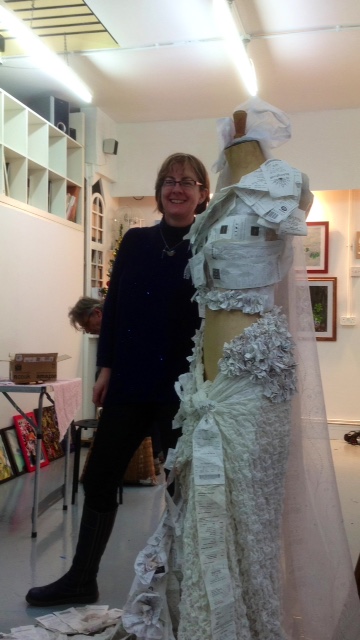
Theresa Nash with her wedding dress crafted out of shopping receipts

But Theresa’s growing enthusiasm for the arts didn’t stop there.  As the Collective itself evolved and we worked more with artists, acquired more art and visited studios and galleries she decided she wanted to have a go herself – not just to look at it, but be an art practitioner! This in turn has made her re-look at the Collective’s collection and examine how and why she values a particular piece.   Spending her Saturdays in art classes and learning about the history of art, she realised how important the stories behind art were and how meeting the artists, as the Collective members do, is an integral part of how we buy and experience art . This was a concept that I also adopted at my work by introducing lunchtime talks with the artists and offering employees the chance to hear the stories around their works.

As part of her own creative journey Theresa wrote a children’s story “make do and mend” which explores addiction through the experience of a girl shopping, as she grows up.  The story was not only turned in to a performance but is being performed as a free event at the Rose Theatre on the 15th May.  Theresa spent two years collecting shopping receipts and hearing stories from contributors in the building of this story and then transformed the receipts in to an art work crafted as a wedding dress .

Theresa cites two important aspects in the influence the Collective has had on her day to day life : continued exposure to the art and artists, and the model of the Collective itself with its cooperative and collaborative structure that has become so central to her projects with artists.

In a recent lecture with her nursing students where she was using a painting to explain a concept – a student jumped up and exclaimed “I get it, I get it! ”  A moment of satisfaction for Theresa as she recognised her own transformative relationship with art in all its manifestations.


Connecting Worlds*

The Collective (minus two) after a recent meeting

There is often a sense that, however much you enjoy your job, what you do outside of working hours is quite separate from what happens within your working environment. This in turn helps to support that much sought after “work-life balance” that so many of us aspire to achieve. As fulfilling as work can be, it can seem that the more removed that interest or passion is from your career the greater the chance that the apparent “balance” may be realised. So whether sports person, actor, singer, artist, writer, poet, tech wizard, what you do with your passion outside of work may improve your sense of well being at the same time.   Perhaps this is true for many people? You spend so much time at work it is sometimes hard to imagine putting a lot of energy in to something quite different – though sometimes it is just what you need to remove yourself from the stresses that can occur in the day-to-day running of your life.

But what happens when external interests and work cross paths and the two worlds meet in an unusual combination – when you have the opportunity to connect both areas of your life? When, as blogger John Stepper would say, you bring your whole self to work.

Although there are arts’ specialists in the Collective, members are, for the most part, from very diverse non-arts professions ranging from local government to teaching, communications, IT, and the NHS. For two of us the influence of the Collective has contributed to producing some unusual projects at work. I have decided to separate the two experiences in to two blogs as they represent very different journeys and professional backgrounds.  The first is my own story.

In 2011, just a few weeks in to my new role as a corporate communications manager at UBM plc I was unexpectedly drawn in to some discussions about refurbishments of the top floor of our office building – a floor that was filled with meeting rooms, UBM’s board room and a long corridor that stretched the length of the building .Various ideas were discussed from themed areas that represented the different businesses, to fresh interior designers being brought in, to new photography to replace the old. As the floor often welcomed external visitors, what would best represent UBM?

For the most part I listened and observed – I was new after all.

Michael Armitage 1
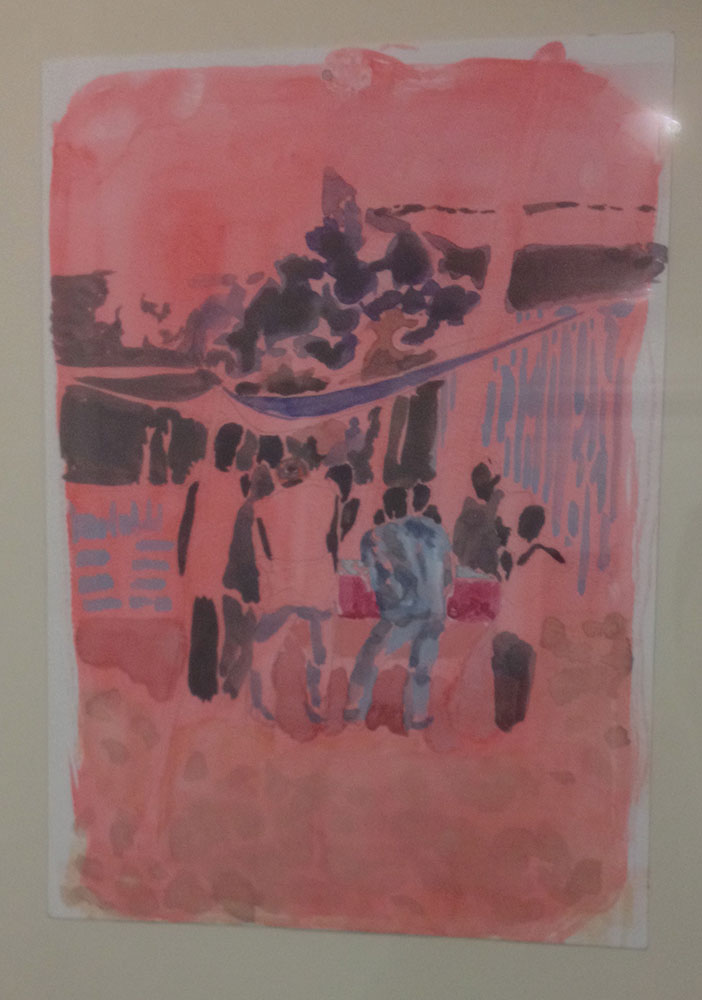
Michael Armitage’s “men by the roadside” – one of the studies exhibited during the project and purchased by the Collective.

In reality, I was already forming an idea, but I needed to work on it first. With over 8 years exposure to contemporary art, artists, galleries and studios through the Collective it would not have taken a genius to know what was going through my head. But my colleagues didn’t know that, and the challenge for me was “what” and “how”.

Over the next few days I discussed with Collective member Tim Eastop what he thought the chances were of UBM, a commercial B2B events-led global organisation, collaborating with a local arts organisation?  UBM had no previous history of supporting the arts (in their London office at least ), but it did have a great track record of local community engagement often supported by their Charity Committee. I leveraged all the experience and contacts the Collective offered and within a couple of weeks came up with an idea for the proposed 9th floor refurbishment that could suit both sides of a collaboration.

A proposal was submitted and much to my amazement – approved. The result was a unique collaboration with Drawing Room, a public non-profit contemporary arts organisation based in Southwark, the London borough where UBM’s head office is located.   The idea was to promote and support emerging artists in a local but global business environment whilst also providing training for an emerging curator .

photo 4 (1)
Mairia Evripidou, UBM Curatorial Intern for the last two exhibitions during an exhibition changeover weekend.

After a meeting with Drawing Room Co-Directors Kate MacFarlane and Mary Doyle the project began to take shape. Under the leadership of Gallery Manager Jacqui McIntosh two sixth-month exhibitions would take place on the 9th floor, and with the help of a curatorial intern, funded by UBM through Drawing Room’s education programme, they would be responsible for researching local artists under agreed themes that resonated with UBM. The second exhibition, “Material Matters” explored the ways artists referenced consumption and mass production and how they responded to recycled materials, tying in with UBM’s own sustainability exploration and journey.

The funding from UBM’s charity committee was initially for 1 year, but was subsequently extended for a further 2 years resulting in 5 exhibitions representing over 30 emerging artists from our own doorstep in Southwark.   The final exhibition “Full Circle” drew artists from the previous exhibitions in the project and focussed on ideas of continuity and change – a concept critical to many business environments, not just that of UBM. As a community engagement project it also included a networking event for local artists and curators as well interested employees.  The project finally ended this year when UBM’s London office moved premises.

The project gave UBM employees at our London HQ an opportunity to see and think differently in their every day working lives. They were challenged, sometimes moved and occasionally mystified; they engaged with a very different professional community brought in to their own business environment; they welcomed the exhibition change every six months (no complacency about what was on the walls), and came to lunchtime talks offered by the artists in order to explore why and how the works of art they saw every day were created.  . Thanks to our internal social intranet other UBM businesses outside of London and the UK were able to
enjoy the works as I shared the project in a curated space for that purpose.

DR1
L-R: Amy-Rose Enskat (UBM Curatorial Intern), Jacqui McIntosh (Drawing Room Project Lead), Ben Deakin (participating artist and technician)

The relationship and collaboration with the Drawing Room team and many of the participating artists was inspirational . The three curatorial interns UBM sponsored have all gone on to good jobs in other arts establishments, and the artists who exhibited continue to move on to new adventures and shows.  A full list of the exhibitions in the collaboration and the participating artists can be found on Drawing Room’s website.

For me? Certainly one of the most memorable projects of my career, when two worlds came together in the most rewarding and fulfilling way I could have hoped for.

Lizi_Sanchez-IIIII
one of our site specific installations at UBM by artist Lizi Sánchez , IIIII, 2014 Acrylic on aluminium foil, 270 x 215 cm (5 panels of 78 x 115 cm overlapped)

* “Connecting Worlds”, the fourth exhibition in the project, explored ideas of community across diverse cultures.